Want to Learn Indian Cooking? The One Thing You'll Need
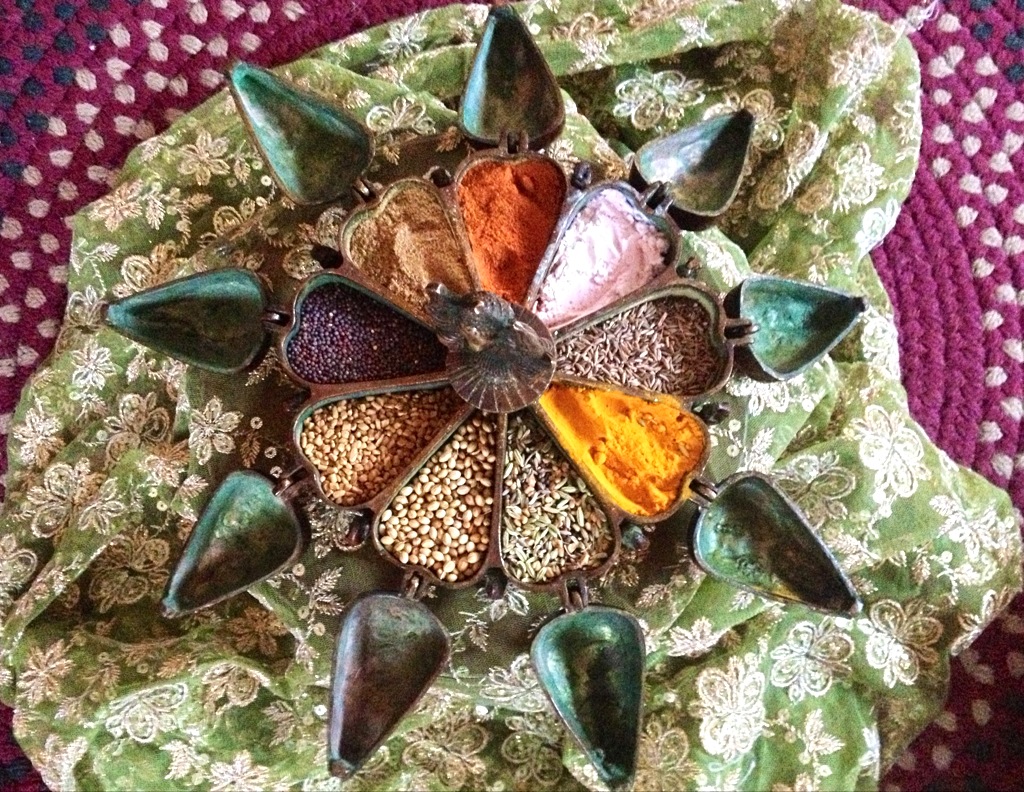
There's no shortage of beautifully colored, fantastically fragrant spices in India.
Perhaps that's why I never fully appreciated or even noticed the all-too-important spice box, or masala dabba. (Even though they are a staple in every Indian household!)
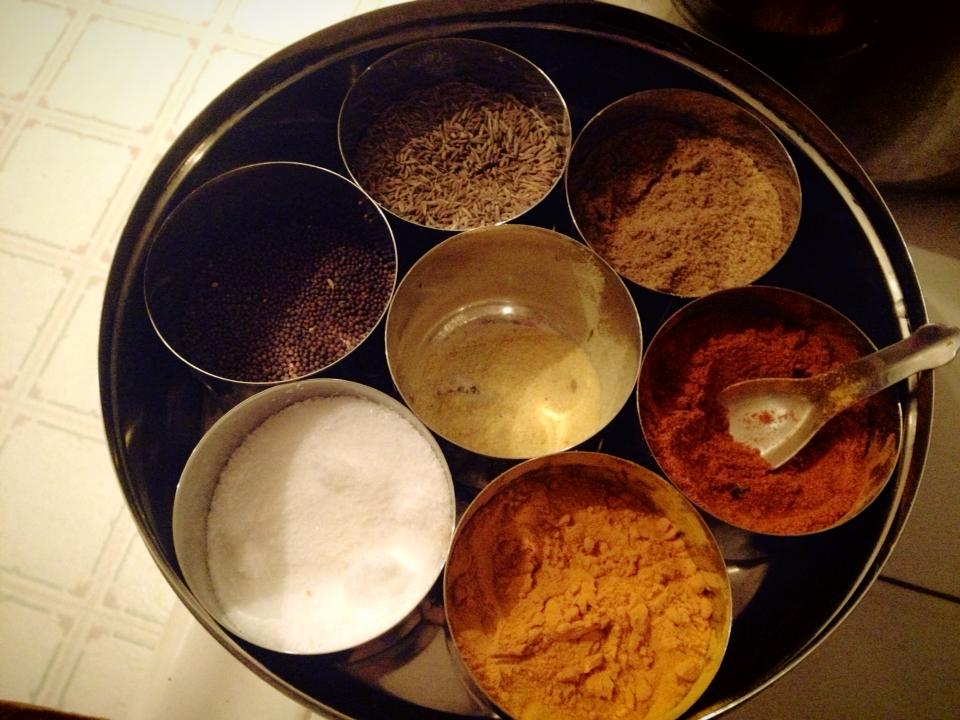
A masala dabba is a round, stainless steel tin with seven smaller spice-containers inside, including a small spoon. The small containers are filled with the most common Indian spices, including but not limited to: mustard seeds, coriander powder or seeds, cumin (jeera) seeds or powder, tumeric, cayenne pepper, garam masala, and asafoetida (hing). Others may include salt, cloves, fenugreek, cardamom, caraway, bay leaves, and ginger. Of course the types of spices can vary depending on the location of the household/region of the cuisine. (Note: I was taught that the seven I listed first are the most commonly used.)
I had the privilege of taking my first Indian cooking course this past weekend, and learned so much more about India and its cuisine. It has been just over a year since I had the chance to visit and, as many of you know, fell in love with India---and I've been seeking ways to keep the experience alive and further explore the culture ever since. After hitting the one year anniversary of my trip, I got particularly antsy looking for ways to get my fill of India. I was pleasantly surprised to find this unique opportunity to continue exploring the country in my own community!
Even before visiting, I'd always loved Indian food---but felt it fairly inaccessible to cook in my own home. I came to learn, as my instructor said,
"You'll be surprised how easy it is to make Indian food at home. It is a myth that it is complicated."
A snapshot of some of the things I took away from the evening (outside of a satisfied stomach and several recipes):
- Each spice has a personality! To teach us about the usage of each, our instructor "interviews" the spices as if they each have separate distinctions and preferences. For example, too much of two different chilis will "fight" in your dish. (Oh, so that's why I should minimize cayenne in a dish that already has chopped green chilis in it?!)
- Whether or not you subscribe to Ayurveda, I love that it is often believed that each spice added to a dish has a purpose and/or health benefit, outside of flavor alone.
- Many Indians believe cooking is a way to offer and express love, which is why "your mother's food always tastes better." :)
- Each ingredient is "offered" into the dish, (instead of 'plopped' like I often cook!) Indian cooking reminds me of how we can be mindful and aware of our senses while cooking. It's as much about the process as the result.
- Eating with your hands, as it is commonly done in India (right hand only please!), is thought to have two benefits/rationales: one, a person's hands usually correlate to the size of their body. Therefore, eating with your hands allows you to eat proper portions at a proper pace for your body size. Second, it has been said that touching your food with your hands can stimulate enzymes that aid in digestion.
- This didn't have to come from an Indian cooking class, but it was certainly demonstrated here: food tastes better when it's fresh, local, and in season!
- As I'm sure you're aware, much of India is vegetarian. Parts of it prescribe to it completely and strictly. I couldn't fathom giving up meat---(because, hello? Bacon.) Yet I am tempted by Indian food to do so. Many of us in the class agreed it was the only way we could be vegetarians. With so many layers of flavor and texture, and all the proteins and nutrients your body could want, our instructor informed us "we wouldn't miss our meat...at least for tonight." She was right.
Perhaps the most valuable aspect of a class, outside of the knowledge and the FOOD, is the people that gravitate toward an experience such as this and the sense of community that is created when everyone is working together to make and share the meal.
In summary: Indian food is so much fun to eat! I feel like it challenges my palate with flavors unlike what I eat on a normal basis. I am happy to report that is it also fun (and easy) to make! I'll be sharing recipes and tips with those of you who are interested in learning more as I go along.
I'm also exploring a few different Indian cookbooks---I am happy to share the ones I like if you want to get started in this adventure but don't have any classes available in your area.
Make Your Own Spice Box
Purchase the stainless steel tin. The best option I've found can be found here (no spices included.) Other options include this

highly-rated box or this

one, with spices included.
Unless the box you ordered came pre-filled with spices, you'll want to fill your spice box with the following: Cumin - Cayenne pepper - Coriander - Tumeric - Garam masala - Mustard seeds - Asafoetida (or you can choose kosher salt, if you prefer)
Fill each of the seven smaller tins about half full with the individual spices. Make sure you now keep the tin horizontal while transporting...or all the spices will mix!
And you're on your way to becoming an Indian chef in your own kitchen! You now have the essentials that make up the base of most all Indian dishes.
Have you cooked Indian food at home before? Is there a cuisine you are curious about, or frequently dine out to, but don't know how to make yourself?
Would you take a cooking class to learn more about a culture? Share in the comments below!